
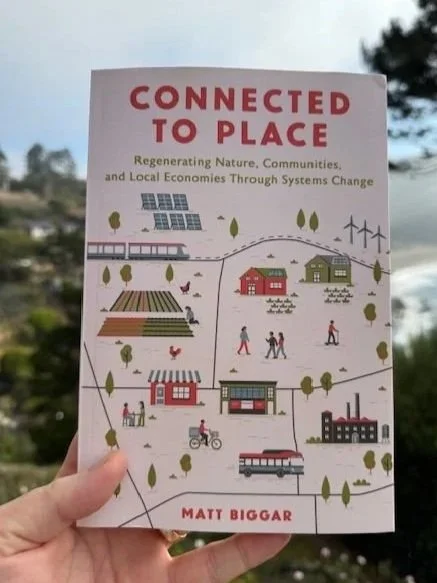
Guide for Book Clubs and Reading Groups
The guide lays out seven sessions for book clubs and reading groups. To have enough time for discussion and synthesis, it is recommended to hold seven or more sessions. However, if time for your club or group is limited, sessions can be combined.
Each session description identifies the relevant pre-reading, main topics, and questions for reflection and discussion.
Please reach out to Matt Biggar (mbiggar@connectedtoplace.com) with any questions.
-
Pre-Reading: Preface, Introduction, Part 1 Opener, and Chapter 1
Main Topics
Disconnectedness/Alienation and 21st Century Crises
Corporate Capitalism
Living Connected to Place
Systems that Shape Human Behavior
Reflection and Discussion
What is your place? How are you currently living “connected to place?”
What’s causing disconnectedness (or alienation) in society and our lives?
What is the relationship among place-based living, addressing our ecological and social crises, and improving human well-being? How can we highlight this relationship and minimize fear and resistance that often gets in the way of people changing their behavior?
What contexts are barriers to changing how we live? How do they show up in your life?
What should the goal(s) of systems change be?
-
Pre-Reading: Chapters 2 and 3
Main Topics
Place-based Systems (Mixed-Use Neighborhoods to Self-Reliant Regions)
Alignment of Place-Based Systems with Well-Being and Regeneration
Systems-Change Levers (Shift Power, Transform Land Use, Reset Culture, Leverage Other Systems)
Reflection and Discussion
How do you define systems? How do place-based systems compare to your prior thinking around systems?
How can place-based systems drive climate solutions and local resilience? How do they support personal well-being? Are there elements of place-based systems where you live that provide some of these benefits?
What evidence do you see of corporate capitalism’s hold on current systems through power, land use, and culture?
Where have you seen any of the four systems-change levers in action?
What idea from Part 1 seems most actionable? What feels most challenging? How can you frame this challenge in a way that displays hope?
-
Pre-Reading: Part 2 Opener and Chapters 4 and 5
Main Topics
Systems Change Levers to Strategies
Housing as Commodity vs. Right
Housing and Local Business/Work Status Quo
Mixed-Income, Mixed-Use Communities
Housing and Local Business/Work Systems Change
Reflection and Discussion
What does the story about Matt’s neighbors (at the start of Chapter 4) reveal about the housing system? What housing challenges have you or others you know experienced?
Is living connected to place that benefits all people possible without mixed-income, mixed-use neighborhoods?
Which systems change strategies do you see as best providing the housing that people need and where it is most needed to enable place-based living?
What explains the demise of local businesses?
Which systems-change strategies do you see as most promising in rebuilding local business and work systems?
-
Pre-Reading: Chapter 6, 7 and 8
Main Topics
Car Dependency
Barriers to Getting Outside
Nature Deficit Disorder
Active, Community-Oriented Transportation
Safe, Car-Free, and Vibrant Community Spaces
Abundant, Accessible, and Nearby Nature Spaces
Transportation, Community Spaces and Nature Spaces Systems Change
Reflection and Discussion
How do you get around in your daily life? Has this changed over time? How has context influenced your transportation choices?
How has your balance between indoor and outdoor time changed over time? If you have child(ren), how does their time outside compare to the time you spent outside as a child?
What do you see as the relationship between corporate power, land use, and culture in locking in car dependency as well as people spending less time outside these days?
Have you experienced a space that brought people together across differences? What could a parking lot or underutilized space in your community become?
Which systems-change strategies do you see as most promising in reducing car dependency and centering community and nature connection more in people’s lives?
-
Pre-Reading: Chapter 9, 10 and 11
Main Topics
Globalized, Industrialized Agriculture and Diets
Centralized, Long-Distance Energy System and Energy Consumption
Global Economy and Consumerism
Local Energy and Food Self-Reliance
Locally Made and Recirculated Goods
Regional Sheds
Food, Building Energy and Consumer Goods Systems Change
Reflection and Discussion
How has your diet shifted over time, and why? Do you eat much local, organic food? Why or why not?
How is your home energy generated? Do you have any choice in the generation of the energy you use?
How has the consumerist system “manufactured” human wants? How has this played out in your life and the lives of people around you?
Where should our food, energy and energy be produced or generated? Should people be able to get food, energy or consumer goods from facilities that they don’t want near their communities, but exist in or near other communities?
Which systems-change strategies do you see as most promising in rebuilding place-based food systems? developing local and regional energy self-reliance? expanding local making and manufacturing and developing regional makingsheds and fibersheds?
Why is conservation and minimizing waste so essential to foodsheds, energysheds, makingsheds, and fibersheds? How can we make it part of our culture?
-
Pre-Reading: Part 3 Opener, Chapters 12 and 13
Main Topics
Systems Change Catalysts
Strategic Collaboration
Collective Power
Essential Conditions for Place-Based Collaboration
Systems Change-Oriented Political Leadership
Restructuring Local Government
Systems-Oriented Government Planning, Policy, and Funding
Role of Regional, State, and Federal Government in Place-Based Systems Change
Reflection and Discussion
What are the 4 systems change levers (review of Part 2), and how do they relate to each other and the 4 systems change catalysts (Part 3)? Suggested activity: Write out the systems change levers and catalysts. Develop a diagram showing which levers each catalyst can pull. Draw connections among the different catalysts that indicate how they can reinforce one another.
What has been your experience with collaboration? What has worked well? What has not?
Which examples of collaborative successes and mishaps in this chapter resonated the most with your experience?
How can we build trusting, valued relationships as a foundation for pursuing a shared, place-based vision?
What did you like about Emily Beach’s or other visionary local leaders’ stories at the beginning of the chapter? Have you known any local leaders like them? Why are politically courageous, visionary leaders important but not enough for changing systems?
How does government need to change to be systems-oriented? Which ideas in the chapter do you think will be most impactful? What steps can be taken to move in the direction of systems-oriented government?
-
Pre-Reading: Chapter 14 and 15
Main Topics
Place-Based Education
Strategies for Centering Place-Based Education in Schools
Sense and Knowledge of Place
Place-Based Identities
Conscious Place-Based Living
Participation in Place-Based Systems Building
Reflection and Discussion
What is place-based education (PBE), and how does it relate to the 8 systems featured in Part 2? What is one PBE learning experience you have had in your life?
How can we make place-based education more central to how children learn in our schools?
What do you know about the past and present of your place? How might you learn more? What does a better future look like in your place?
How can you be a light for others and participate in the building of place-based systems?
Re-introduce yourself, using a place-based identity.